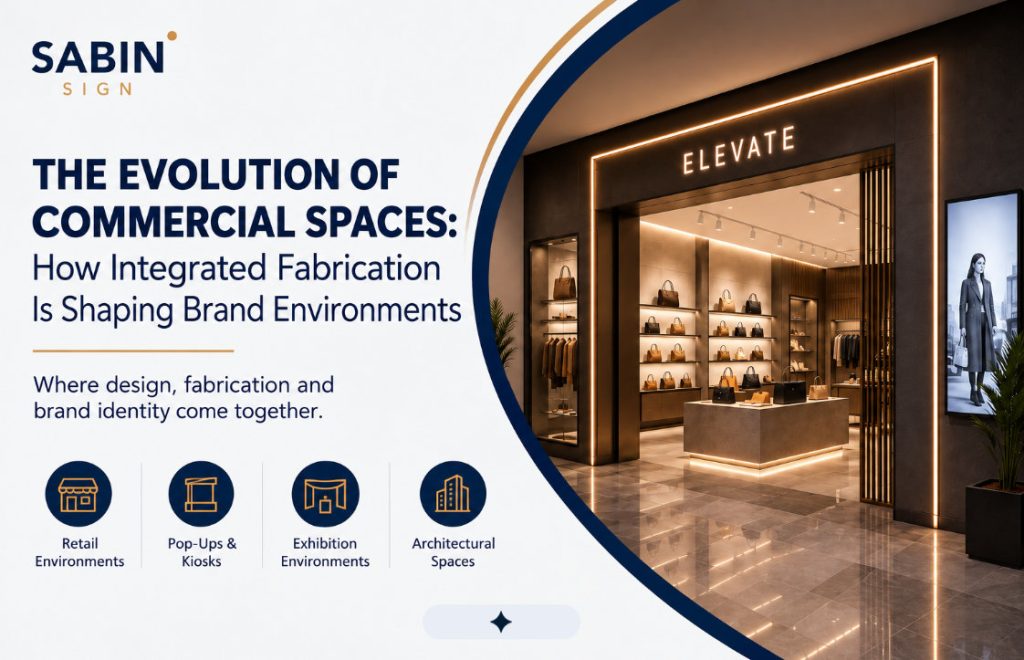
Commercial spaces are no longer simply places where businesses operate or products are displayed. Increasingly, they are becoming physical expressions of the brand itself.
From retail stores and pop-ups to kiosks, exhibitions and corporate environments, the physical space now plays an important role in how people experience a brand. Architecture, furniture, lighting, graphics, digital elements, signage and finishes all contribute to the overall impression.
As expectations change, commercial environments are becoming more bespoke, experiential and interconnected. Individual elements are no longer always designed in isolation. Instead, they are increasingly considered as parts of one complete environment.
This evolution is also changing the role of fabrication — from producing individual components to helping transform a design concept into a physical brand experience.
From Individual Elements to Complete Brand Environments
A commercial environment may contain dozens of different elements, but the customer ultimately experiences them as one space.
A premium retail pop-up, for example, may incorporate architectural structures, custom counters and furniture, product presentation areas, lighting, graphics, digital displays, signage and distinctive feature elements.
Individually, each performs a particular function. Together, they create the character of the environment.
This is an important shift in commercial design. The focus is moving beyond individual fabricated items towards considering how the entire physical environment communicates the brand.
The result is greater emphasis on continuity across form, function, finishes and visual identity.
Retail Is Becoming More Experiential
The change is particularly visible in physical retail.
With customers able to discover and purchase products through multiple digital channels, physical retail increasingly has another role to play: creating an experience that cannot be replicated on a screen.
Premium stores, shop-in-shop concepts, pop-ups and brand activations are therefore becoming more distinctive and immersive.
A counter is no longer necessarily just a functional surface. It can become a central design feature. Product displays can form part of the architecture. Lighting can be incorporated into furniture and structures. Graphics and digital elements can become part of the interior rather than being applied as an afterthought.
For brands, the physical environment itself becomes another way of communicating identity.
Pop-Ups Are Becoming Complete Temporary Environments
Pop-ups are a particularly interesting example of how commercial spaces are evolving.
Although temporary, today’s premium pop-ups can be as carefully designed as permanent retail environments.
Within a limited footprint and timeframe, a brand may need to create a recognisable architectural identity, display products effectively, accommodate customer interaction and deliver a memorable visual experience.
This can bring together custom structures, joinery, furniture, lighting, graphics, digital content, branding and feature elements within one temporary environment.
The temporary nature of the space does not reduce the importance of the experience. In many cases, it increases the need for the environment to make an immediate impact.
Kiosks Are Becoming Miniature Brand Environments
Kiosks are evolving in a similar way.
A modern kiosk is no longer simply a counter with a logo. Within a compact footprint, it may need to accommodate product presentation, customer interaction, storage, digital screens, lighting, graphics and branding while maintaining a strong visual identity.
Every part of the space has both a functional and aesthetic role.
For brands operating in malls, airports and other high-footfall commercial locations, the kiosk can effectively become a miniature version of the brand’s wider retail environment.
This has transformed kiosk design from a relatively functional exercise into one that combines architecture, interiors, product presentation and branding within a highly efficient space.
Exhibitions Are Moving Beyond the Traditional Booth
Exhibition environments are also becoming more experience-led.
Brands increasingly use exhibitions not simply to display products or distribute information, but to create temporary destinations where visitors can interact, explore, meet and experience the business.
A contemporary exhibition environment might incorporate architectural structures, product presentation areas, meeting spaces, feature walls, counters, lighting, graphics and digital content.
The objective is to create a space that communicates the brand quickly and effectively within a highly competitive environment.
As a result, the traditional idea of an exhibition “booth” is increasingly giving way to the concept of a temporary branded environment.
Brand Identity Is Becoming Part of the Architecture
This evolution extends beyond retail and exhibitions.
Corporate and other commercial environments are increasingly incorporating brand identity directly into their architectural and interior language.
A reception area can become a distinctive feature rather than simply a desk positioned in front of a logo.
An entrance or façade can integrate architectural forms, metalwork and cladding, illumination and signage into one visual statement.
Wayfinding can follow the materials, forms and visual language of the interior rather than appearing as an independent system introduced later.
The boundaries between architecture, interiors and branding are therefore becoming less defined.
Rather than adding the brand to a finished space, designers can increasingly make the brand part of the space itself.
What This Means for Fabrication
As commercial environments become more bespoke and interconnected, translating them from concept into physical form can involve several fabrication disciplines.
Depending on the project, this may include architectural metalwork, fit-out and joinery, acrylic and polycarbonate fabrication, signage and wayfinding, graphics, lighting, specialist finishes and custom fabricated features.
The role of fabrication is therefore broader than producing individual items from drawings.
It is about understanding how different fabricated elements contribute to the overall design intent and helping turn that concept into a buildable environment.
At Sabin Sign, capabilities across architectural metalwork, fit-out and joinery, acrylic and polycarbonate fabrication, architectural signage and wayfinding, retail and branded environments, exhibitions, kiosks and structural acrylic installations support this changing approach to commercial spaces.
The focus is not simply on what can be fabricated individually, but on what those capabilities can help create together.
The Future of Commercial Spaces
Commercial environments will continue to evolve as brands place greater importance on physical experience.
Retail will become more experiential. Temporary spaces will become more sophisticated. Digital and physical elements will increasingly interact. Brand identity will become more closely connected with architecture and interiors.
And the distinctions between a fixture, a display, a sign, a piece of furniture and an architectural feature will continue to become less obvious.
For architects, designers and brands, this creates greater freedom to think about commercial spaces as complete experiences rather than collections of individual components.
For fabrication partners, it creates a broader role – helping transform those increasingly ambitious ideas into physical environments that can be experienced in the real world.
At Sabin Sign, we bring together the fabrication capabilities required to help turn design intent into distinctive commercial and architectural environments.
Planning a retail, commercial or architectural project?
Speak to Sabin Sign about bringing your concept to life.